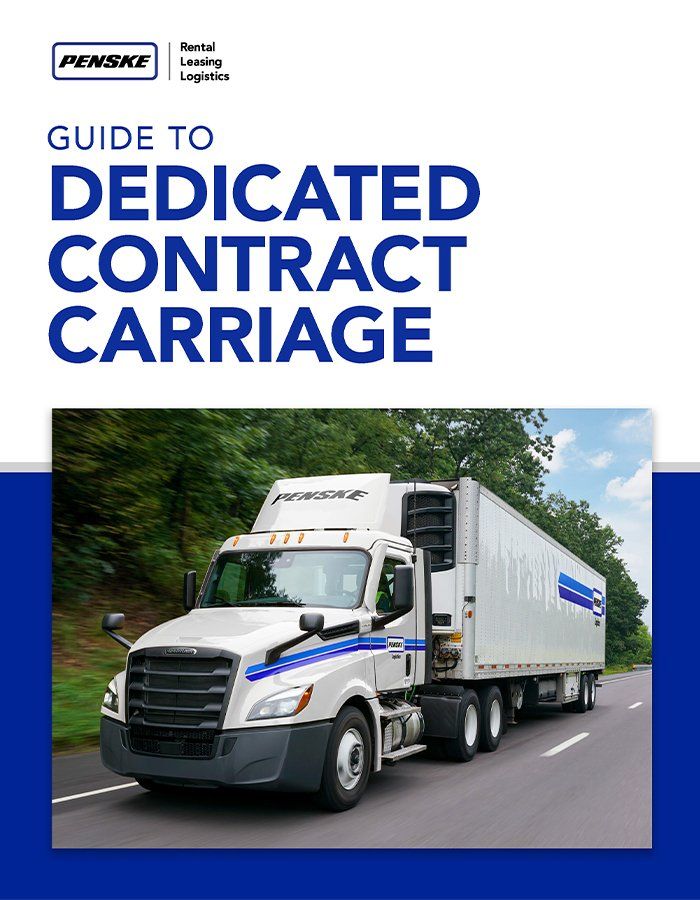
In many consumer-facing businesses, logistics is more than a means for moving products from point A to point B – it is an integral part of the brand itself. This is why shippers in these markets often choose dedicated contract carriage (DCC) as their preferred trucking logistics option.
Consider quick-service restaurants (QSR). Efficient and timely delivery is critically important in an industry built on selling fresh food to consumers. But professionalism and customer experience matter just as much, because drivers and these trucking services and their drivers can come into direct contact with store customers when product is stocked on shelves during regular hours.
In the DCC model, the logistics service provider operates as a seamless extension of the QSR team - aligning with and actively supporting the company's brand at every touchpoint.
Distinct Benefits
Dedicated contract carriage is defined as "a for-hire carrier, dedicated and contracted exclusively to one shipper."
Businesses that use this model direct the execution of resources through a dedicated agreement, while handing off the day-to-day responsibilities of managing a private fleet. That shift may sound simple, but the impact can be significant.
Relinquishing a non-core competency - such as fleet management and truck deliveries - frees QSRs to sharpen their focus on what they do best: marketing, menu innovation and customer engagement. Just as important, they gain access to the expertise of an external logistics specialist without surrendering control of their all-important customer-facing experience.
Unlike private carriage - which burdens shippers with full fleet management responsibilities - or a common carriage, which sacrifices operational control for convenience, DCC offers the best of both worlds. In many cases, the decision to transition to a DCC model is triggered by a change in senior leadership, a strategic drive to reduce cost or risk or a broader shift in business strategy.
Finer Focus in Action
To see what DCC looks like in practice, consider a leading QSR chain that set out to improve the freshness of key products. Achieving that goal required more frequent restaurant deliveries and a redesigned distribution model that incorporated direct-to-store delivery options.
The company turned to Penske Logistics for a dedicated contract carriage solution. Penske conducted a thorough analysis of the chain's distribution network, delivery frequency, operating hours and driver responsibilities, then built a tailored network around those requirements. This included a significant investment in temperature-controlled trucks and distribution center freezer capacity to support the company's 24/7/365 delivery demands.
Driver training is a key cornerstone of the DCC operation Penske provides. Roughly one-third of the client's restaurants are still open when drivers arrive to restock shelves, making it essential that every driver is well trained, reliable and genuinely committed to customer service. Drivers must also demonstrate proficiency in food handling - including compliance with food safety regulations, proper storage practices and the correct use of specialized equipment. Before being assigned a route, drivers complete a dedicated training program, followed by a supervised period alongside an experienced driver.
"Training is one of the most expensive things we do. People say it's expensive, but it's even more expensive not to train."
– Andy Moses, senior vice president of solutions for Penske Logistics
The DCC agreement also shielded the QSR chain from the burden of driver-related staffing tasks and associated expenses. Equally important, the company avoided the need to build out an extensive logistics infrastructure to support its new strategy and meet customer experience goals across dozens of locations.
"The model allows them to devote these resources to other aspects of promoting their products. Also, having a reliable outside expert to provide the logistics services they need gives them more confidence to introduce new products faster and stay ahead of market changes," says Kandice Nadeau, vice president of dedicated contract carriage for Penske Logistics.
Competing on Brand
Brand-drive DCC models are poised to grow in importance - particularly in sectors like food service, where consumer buying patterns are evolving rapidly. Beyond reliably and cost effectively replenishing fresh product, a high-performing DCC operation can become virtually indistinguishable from the client's own brand - through vehicle branding, driver uniforms and customized delivery schedules designed around the unique demands of each store location.
But not all providers are created equal. "It's important that companies choose a DCC provider capable of delivering on its service promises. Look for a provider with depth of experience that can bring best practices to your customer operations," said Nadeau. The right DCC partner doesn't just move products - it protects and strengthens your brand with every delivery.
Ready to take the next step? Download the Guide to Dedicated Contract Carriage to explore the options in depth or contact us to discuss a solution tailored to your business.