
Supply chain data is exploding in volume, yet many supply chain leaders describe their logistics data as rich but insight-poor. That gap reveals a deeper problem: as supply chains become increasingly outsourced, the operational data driving key decisions is now largely generated and held by third parties.
For many organizations, that data remains fragmented and outside of their control – creating a fundamental challenge. In a presentation at the Gartner® Supply Chain Symposium/Xpo™, Jose Reyes, Senior Director Analyst at Gartner, shared that, “Execution can be outsourced. Data control cannot.”
Execution can be outsourced. Data control cannot.
– Jose Reyes, Senior Director Analyst at Gartner
The amount of data available is growing exponentially within the supply chain. According to IDC predictions, global digital data is projected to surpass 700 zettabytes by 2030. Much of the data needed in supply chains is generated and lives outside of the organization. This is supported by Gartner research that has found that 75% of organizations outsource some or all logistics services, with that number expected to reach 88% by 2028.
Organizations that take control of their data will have data visibility, strategy and standards to control their data even if it lives outside of the organization. Andy Moses, senior vice president of sales and solutions for Penske Logistics, said, “The outsourcing of logistics data is a strategic risk if companies do not have visibility into the operational signals that drive their supply chain.” Taking control of data means working with partners who supply that data and maintaining the ability to see it in real time, integrate it and gain insights to make faster decisions.
What Is at Stake: The Data That Drives Supply Chain Performance
Shipment status, inventory movement and cost-to-serve analytics are all critical data inputs that provide visibility into the efficiency, profitability and reliability of supply chain operations.
Shipment status enables organizations to proactively manage disruptions, improve customer communication and ensure on-time delivery performance. Insights into inventory movement help companies reduce carrying costs, identify slow-moving or excess stock and pull from ideal locations.
Cost-to-serve reveals the true expense of moving freight across customers, products and channels. It requires knowing not only that a shipment moved from point A to point B, but what it cost to handle at the warehouse, which carrier delivered and at what rate, whether it arrived on time and in full, and how those factors varied by customer or lane. Without execution data from all supply chain partners, that level of analysis is impossible.
The competitive advantage going forward will belong to those organizations that control their logistics data and use it to improve company-wide operations, not just execute logistics. The ability to access, standardize and operationalize logistics data is becoming foundational to end-to-end orchestration, AI adoption and operational decision-making. Yet, Gartner’s research found that “29% of supply chain leaders do not have a clear understanding of their function’s data strategy.”
There are several common challenges organizations face when logistics data is managed across multiple providers – including delayed access to information, inconsistent data formats and limited readiness for AI and automation initiatives – challenges that become even more pronounced across fragmented networks.
Data Visibility Has Become an Operational Requirement
Reyes outlined three core enterprise outcomes that are directly connected to logistics data: revenue growth, cost control and AI readiness. “All three depend on logistics execution data.”
AI initiatives increasingly depend on operational execution data, such as estimated time of arrival (ETA) predictions, disruption detection and routing optimization. Real-time operational data also supports end-to-end orchestration – coordinating decisions and shipments across the entire supply chain by helping shippers and their logistics provider monitor shipment delays, inventory movement and capacity constraints.
Data also supports cost-to-serve transparency, giving organizations the granular data needed to understand the true cost of each decision rather than spreading costs evenly across transactions. That lack of visibility often leaves supply chain leaders without clear answers when their CEOs ask about logistics costs – and for many, the honest response is that better data access is a work in progress.
The Shift to Continuous Transparency
Moses said customer expectations have accelerated the need for continuous visibility. “The days of batch-oriented review processes are in the rearview mirror,” he said. “Customers want to know at midnight where their freight is and whether it is going to arrive on time. That expectation requires around-the-clock access to operational data.”
Customers want to know at midnight where their freight is and whether it is going to arrive on time. That expectation requires around-the-clock access to operational data.
– Andy Moses, senior vice president of sales and solutions for Penske Logistics
Historically, many logistics providers managed customer reporting through periodic business reviews that curated operational performance metrics. The industry is now shifting toward continuous transparency. Penske has built that transparency into its Supply Chain Insight platform, giving customers direct access to operational data in real time. “With Supply Chain Insight, customers see the same thing we see when we see it,” Moses said. “It is full transparency.”
The platform was designed to capture not only Penske’s execution data, but also data from trading partners across transportation, warehousing and final-mile operations – an architecture that reflects the reality that most large shippers operate across multiple providers and systems. Penske developed the platform after recognizing that many organizations lacked the internal resources to unify disparate logistics data streams on their own, a process that can require years of investment and significant IT resources. “When we evaluated the market, we did not see a platform capable of bringing all of those functions together in a meaningful way,” Moses said. “It takes significant effort to integrate supplier data, transportation data, warehouse information and final-mile visibility into a single operational view.”
Regardless of where information originates, organizations should establish unified data standards across logistics providers and embed data-sharing requirements into contracts – specifying exactly which data elements a provider must share, in what format, how frequently and at what level of accuracy. Equally important is testing data readiness before integrations occur and developing provider scorecards that include data quality metrics.
Data Quality Is Becoming a Performance Metric
Logistics data governance cannot stop at visibility alone – organizations must continuously monitor data quality and enforce standards across providers. Key metrics to track include data accuracy, timeliness, completeness and consistency.
Moses said those measurements mirror the same operational rigor traditionally applied to cost and service metrics. “To have good data, companies must invest in process management,” he explained. “Data quality is no longer separate from operational performance. It is part of operational performance.”
That shift is becoming even more critical as organizations pursue broader orchestration and AI initiatives, where data standardization is a prerequisite, not an afterthought. Reyes noted that "in a data-driven logistics network, data quality must be managed with the same rigor as cost and service performance.” Consistency is perhaps the hardest standard to achieve at scale – near-perfect performance is not enough, and organizations must aim for full reliability across every transaction, every week. Reyes added that “data governance only creates value when it is enforced consistently across logistics partners.”
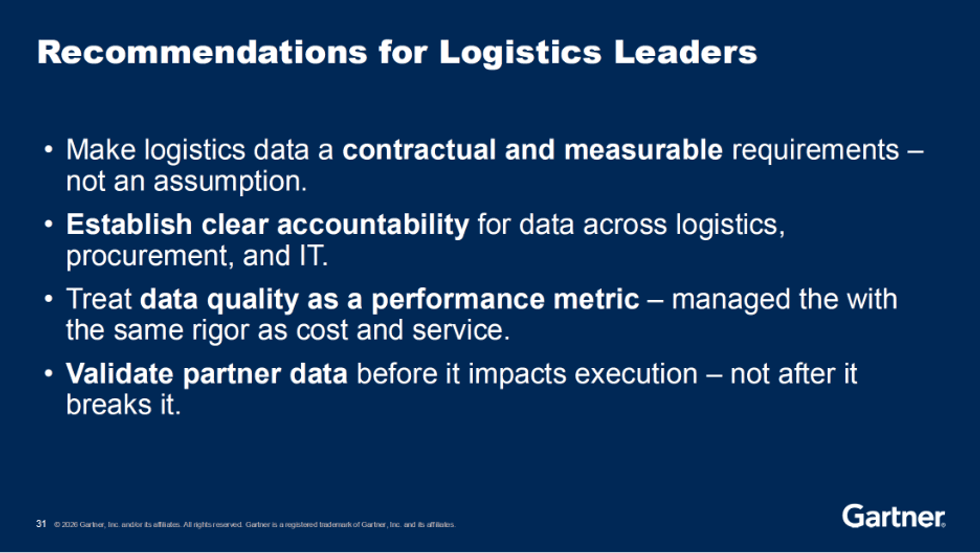
As per Gartner, “recommendations for logistics leaders include:
- Make logistics data a contractual and measurable requirement, not an assumption.
- Establish clear accountability for data across logistics, procurement and IT.
- Treat data quality as a performance metric - managed with the same rigor as cost and service.
- Validate partner data before it impacts execution - not after it breaks it.”
Data Command as a Competitive Differentiator
Organizations that successfully integrate and activate logistics data across their networks will be better positioned to respond to disruptions, improve customer service and scale future technology investments. “Good intentions alone are not enough,” Moses added. “Companies need infrastructure that allows them to operationalize logistics data across their entire network in real time.”
Penske built Supply Chain Insight specifically to close that gap and give shippers unified visibility across their full logistics network. It connects transportation, warehousing and third-party systems in real time, so customers can proactively manage exceptions, eliminate blind spots and minimize delays. Users can also access up to 13 months of historical performance data to evaluate trends, measure the impact of operational changes, and distinguish between isolated disruptions and structural issues.
As logistics networks become more complex and increasingly outsourced, the organizations that thrive will be those that treat data as a strategic asset. Visibility, quality and governance are no longer back-office concerns – they are competitive differentiators that directly influence orchestration, AI readiness and customer experience.
Logistics data now shapes decisions, performance and governance, and the leaders who recognize this shift will be those who take control of the data that underpins their entire operation. The message is clear: “future supply chain leadership won’t be defined by asset ownership – but by data command,” said Reyes.
Penske’s Supply Chain Insight platform can help your organization take command of logistics data. Contact us to learn more.
[Gartner Supply Chain Symposium Presentation, No Data, No Orchestration: Why CSCOs Must Take Command of Logistics Data, Jose Reyes, May 4-6, 2026].
GARTNER is a trademark of Gartner, Inc. and/or its affiliates.
DISCLAIMER: The content provided is for general informational purposes only. Penske makes every effort to ensure the accuracy of the information presented; however, the information herein is provided without any warranty whatsoever, whether express, implied or statutory. In no event shall Penske be liable for (i) any direct, incidental, consequential, or indirect damages (including loss profits) arising out of the use of the information presented, even if Penske has been advised of the possibility of such damage, or (ii) any claim attributable to errors, omissions, or other inaccuracies in connection with the information presented.