
Beyond on-time delivery: the numbers that drive smarter, more profitable DCC operations
In today's complex supply chain environment, dedicated contract carriage (DCC) offers shippers two increasingly valuable advantages: committed capacity and operational consistency. But securing those advantages is only part of the equation. The metrics shippers and carriers track together are what transform a dedicated fleet into a true competitive advantage.
"Shippers are turning to us now for more capacity as they struggle with non-contracted dedicated carriers. We work with our customers on DCC metrics and reason codes because understanding the data is how we get better, keep costs down, and build partnerships that last," said Kandice Nadeau, vice president of dedicated contract carriage for Penske Logistics.
On-Time Delivery
While there are several critical metrics, Nadeau said on-time delivery is the No. 1 figure everyone tracks. The definition of on-time delivery can vary by shipper based on their performance criteria. "With some shippers, if you tell them you're going to deliver Friday, as long as you get there on Friday, it is on time. Other shippers are much more specific, and if you're a minute early or a minute late, it is considered a not on time shipment," she said.
For on-time deliveries to occur, on-time departure is essential. "One of the metrics that we're finding useful for the whole supply chain is on-time departure with reason codes. It helps us understand if we're not off to a good start, why and how to mitigate that in the future," Nadeau said. "Lots of things can happen once you're on the road that may be out of our control, but the driver being on time, the truck being there and ready to be loaded, then getting loaded and out the gate is the first step to ensure on-time delivery."
Equipment must be reliable, and Penske utilizes a rigorous preventive maintenance program to drive up time. Penske has 24/7 roadside service and rental vehicles to keep products moving in the event of a breakdown.
Knowing a truck left on time is one thing - knowing what's happening throughout the entire journey is another. Penske's ClearChain® technology suite is where supply chain data is created, managed and executed. It pairs the best software on the market with custom tools built in-house to tackle complex supply chain challenges that standard software alone can't handle.
Building on that foundation, Supply Chain Insight provides real-time visibility across the entire supply chain - load, order and item-level data all in one place - so it's easy to see what's moving and flag what needs attention before a small delay becomes a big problem.
"We look at the variables and mitigate the impact on our on-time delivery. We must overcome as many variables as we possibly can," Nadeau said. "We also use geofencing for our departure and our arrivals, so the information is reported back and recorded in that dispatch platform. We know exactly what time product is leaving and when it is delivered."
Cost-Per-Mile
Most transportation expenses are tied directly to the mile. "Fuel is consumed by the mile and drivers are paid by the mile, so it is important to understand what your cost-per-mile is," Nadeau said. But that doesn't tell the full story on its own. Cost-per-mile goes hand in hand with cube percentage - a measure of how fully loaded trailers are when they hit the road. "You may have a low cost-per-mile, but if you have trailers pulling out a quarter full, you're not necessarily efficient."
Cost-to-Serve
In a multi-stop fleet configuration environment, cost-per-stop is a useful starting point - but it can paint a misleading picture. Cost-to-serve drills deeper, isolating the true expense associated with each individual customer stop. "Cost-per-stop is you take your total expense and divide it by the number of stops. It is much more specific to an individual customer," Nadeau said. "You're taking into account that portion of the route that truly is dedicated to that customer."
Consider a 1,000-mile route with four stops, where the third stop is 300 miles out, and the fourth stop is 700 miles out. Treating those two stops as equal shares of the route cost would misrepresent what it costs to serve each location. "It isn't fair to take four stops divided by the cost of that route and allocate that cost to each one of those stops. We can determine the cost-to-serve for each stop to give you the true barometer of your costs," Nadeau said. That level of specificity gives shippers a more accurate foundation for pricing, network planning and customer profitability analysis.
Utilization
Tractor, driver and trailer utilization each tells a different part of the efficiency story. Tractors represent a significant capital investment and don't require rest, so maximizing their up time makes financial sense. "Ideally, you can run them 24 hours a day if it fits with your delivery windows," Nadeau said.
Driver utilization is where the balance between productivity and safety becomes critical. Rather than running drivers up to their maximum hours-of-service, Penske targets around 55 hours per week. "Even if the driver doesn't feel like they're burned out, they could be fatigued and lose some of their capability to operate the vehicle safely," Nadeau said.
Trailer utilization rounds out the picture. When trailer-to-tractor ratios creep up, it's often a sign that equipment is sitting idle or being used as overflow storage. "You want to make sure that trailers aren't sitting idle too much or being used to store product instead of used on the road," Nadeau said. Monitoring the ratio helps right-size the fleet and avoid unnecessary equipment costs.
Empty Miles
Empty miles are an unavoidable part of trucking, but that doesn't mean they can't be managed. Tracking them provides a clear picture of where capacity is being wasted and opens the door to solutions - whether that's optimizing the network or finding backhaul opportunities that offset and improve overall efficiency.
Detention Time
Detention is a cost that's easy to overlook but difficult to ignore once it starts adding up. Every hour a driver spends waiting at a dock is an hour of lost productivity. Tracking detention time - and pinpointing where it's occurring - provides the information needed to identify patterns, address route causes and work toward reducing over time, Nadeau said.
Safety
Every metric in a DCC operation ultimately connects back to safety. No efficiency gain, cost saving or on-time delivery is worth compromising the well-being of drivers and the communities they travel through.
Penske monitors a range of safety metrics - including speed and hard braking events - not just to measure performance, but to create opportunities for timely, meaningful coaching. "If we see an incident, we want to be able to meet with a driver and provide coaching in a minimal amount of time, so it is still fresh in their mind before they make the same mistake again," said Nadeau.
On-board cameras make that coaching more effective, provide objective, real-world context that helps drivers understand and correct behaviors before they become habits.
Data Quality
The metrics discussed here are only as valuable as the data behind it. Tracking the right numbers means nothing if the numbers can't be trusted. "You must have systems and processes in place that make sure the data is accurate. You lose credibility if people are questioning the data," Nadeau said.
That's why Penske invests in the systems, processes and people needed to maintain data integrity across every layer of a DCC operation. The company's 24/7 Transportation Support Services helps ensure that the data driving decisions are accurate, consistent and reliable.
When the right metrics are tracked, the data is trustworthy and shippers and carriers are working from the same information, dedicated contract carriage becomes more than a transportation solution - it becomes a strategic advantage. That collaborative, data-driven approach is what turns a fleet of trucks into a competitive edge.
The right metrics start with the right partner. Contact us to explore how a dedicated contract carriage solution can drive efficiency and cost control across your supply chain.

DISCLAIMER: The content provided is for general informational purposes only. Penske makes every effort to ensure the accuracy of the information presented; however, the information herein is provided without any warranty whatsoever, whether express, implied or statutory. In no event shall Penske be liable for (i) any direct, incidental, consequential, or indirect damages (including loss profits) arising out of the use of the information presented, even if Penske has been advised of the possibility of such damage, or (ii) any claim attributable to errors, omissions, or other inaccuracies in connection with the information presented.
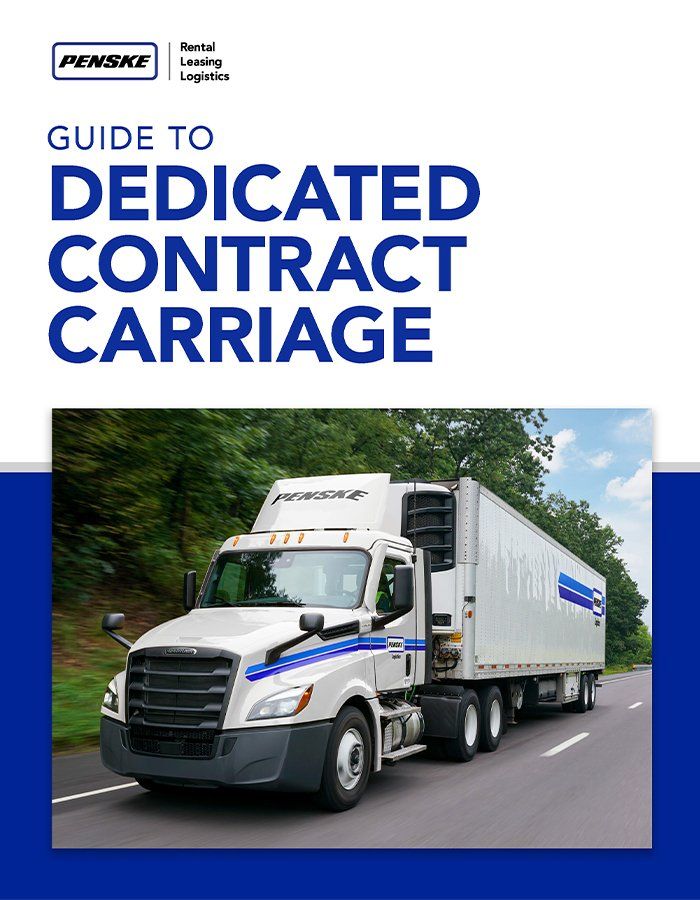
Download our Free DCC Buyer's Guide
All fields marked with an asterisk (*) are required.
Thank you for your request.
You will soon receive a confirmation email with a link to download your DCC Buyer's Guide.
Related Articles
Resource Library
Explore articles, case studies, e-books and industry reports from our logistics experts.
Explore More